

How To Change Template Joomla 2.5
<sidebar>
- Joomla!
- http://world wide web.joomla.org | Main
- http://community.joomla.org | Community
- http://forum.joomla.org | Forum
- http://extensions.joomla.org | Extensions
- http://shop.joomla.org | Shop
- http://developer.joomla.org | Developers
- http://api.joomla.org | API
- J2.five Getting Started Tutorials
- Tutorials:Beginners|Beginner Tutorials Main
- J2.5:Getting Started with Joomla!|Getting Started with Joomla!
- J2.5:Getting Started with Templates|Templates
- J2.5:Getting Started with Categories|Categories
- J2.5:Getting Started with Articles|Articles
- J2.v:Getting Started with Menus|Menus
- J2.5:Getting Started Modules|Modules
</sidebar>
Intro [edit]
This introductory tutorial will give you an insight into the Joomla! templating system and what you tin can do with it.
Purpose of templates [edit]

A template controls the overall look and layout of a site. It provides the framework that brings together mutual elements, modules and components equally well every bit providing the cascading fashion canvas for the site. Both the front-end and the back-end of the site have templates.
When Joomla! is first installed several templates are automatically included. You tin can find many more templates at other websites. Some are available without charge under various licenses, and some are for auction. In addition, there are many developers available who can make custom templates. You tin can besides brand your own template.
Templates are managed with the Template Manager, which is located on the Extensions menu in the back-end (administrator) expanse of your site.
Why does Joomla! utilise templates? [A real beginners guide!] [edit]
The manner Joomla! is designed separates out the key tasks involved in producing a website for efficient maintenance of the software. One of these tasks is to create the aesthetic (the await, experience and layout) of the site. This includes making decisions such equally which content elements (components, modules and plugins) you may want to place in any given page.
When producing a web page, the location of virtually elements volition stay the same (menus, banner locations, sidebars etc.). Additionally, you will want to create the same look (fonts, header styles, colour scheme etc.) for every page. For some parts of the site you may want to alter the general feel to indicate a different purpose for those pages (such equally a blog section). A fiddling planning is required for this, but once yous have settled on the overall layout for your site, you so have the task of producing each page of content.
And that'due south where the template comes in. You tin either write all the code for each page separately, or use a template for each major section of your site so that when you desire to create a new page you simply "make full in the blanks". Okay, mayhap information technology's not that elementary, but this tutorial is designed to give you a stride by footstep guide for effective template use, starting with how to use i and ending with how to create one for yourself.
- Utilize one of the templates supplied with Joomla!
- Download one of the many free offerings from the Internet.
- Pay for ane to be modified or produced from scratch if your needs cannot be met whatever other way.
Summary – a template controls the expect of your site and at the same time allows the website administrator focus more than on the bodily content.
What can you practise [edit]
A template is used to dispense the style content is delivered to a spider web browser or screen reader. Here are some ways you can employ this on your Joomla!-powered site.
Layout [edit]
The template is the place where the design of the principal layout is set for your site. This includes where you place dissimilar elements (modules). For example: You can command the placement of menus, a log in form, advertising banners, polls, etc.
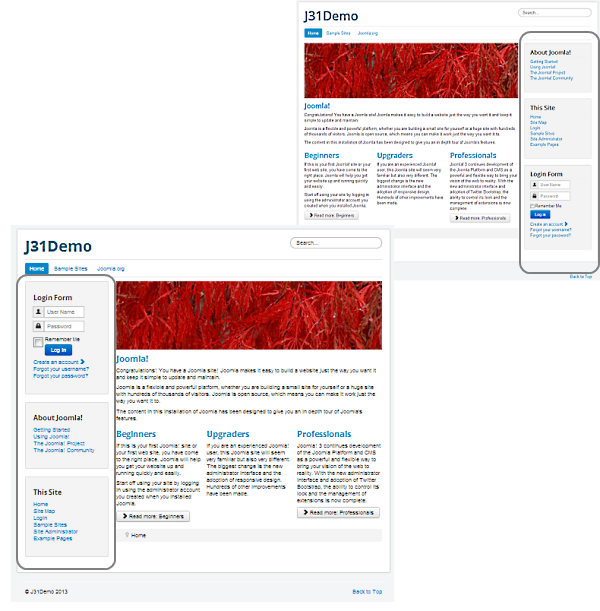
The chief trunk(article) of the page tin be contradistinct in style(yous tin can select from different styles of display such as typical weblog layout, a news article, etc) depending on the templates layout. *Run into the case image. Note the differences in layout, but how the look is consistent. The sidebar of modules has been moved from left to right and its order rearranged.
If the template is designed to provide choices, yous can also "dynamically" change the content placement on your site, perhaps putting the master menu on the right or left side of the screen.
Color Scheme [edit]
Using CSS within the template design, you can alter the colors of your backgrounds, text, links or just near anything that yous could within your ordinary HTML code. Some templates provide a method to alter the colour in template management, others require you lot to alter the template'due south .css file(s).
Images and Effects [edit]
You can also control the fashion images are displayed on the folio, and even create flash-similar effects or include AJAX applications such as driblet-downwards menus.
Fonts [edit]
The same applies to fonts. The designs for these are all set inside the template's CSS file(s) to create a compatible await across your unabridged site, which makes it fantastically easy to change the whole look merely past altering one or ii files rather than every single page.
Browser Specific Solutions [edit]
A template tin be designed to change how information technology displays on dissimilar web browsers, allowing yous to take total advantage of the latest developments without making your site inaccessible to those who are non able to run "up-to-the-infinitesimal" system upgrades (such as certain companies who limit what software their employees can use).
Templates Supplied [edit]
The following templates are supplied with a default installation of Joomla! 2.5
Site Templates [edit]
- Beez twenty (Default template)
- Beez 5
- Atomic
Ambassador Templates [edit]
- Bluestork (Default template)
- Hathor
Switching Templates [edit]
To change the default Template for the Site (Front-finish) or Ambassador (Back-end), follow these steps:
- Log in to the Administrator (Dorsum-end). If you are not certain how to do this meet: To log in to the Administrator (Back-end)
- Click on: Extensions -> Template Managing director

You volition now run into the Template Manager screen.
Note: If you lot do not see Template Managing director listed as an option on the Extensions menu, then it is well-nigh probable because you are not logged in as a Super Administrator. But Super Administrators will see this menu item.
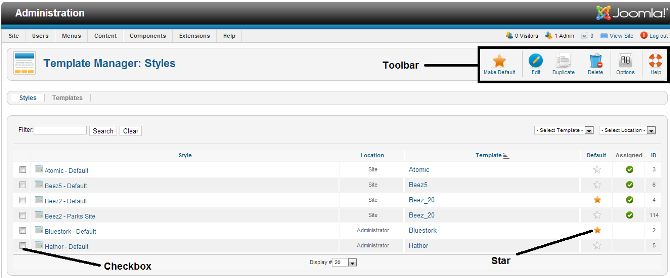
From here you manage your templates for Front-end and Back-stop. The default view shows your installed Front-cease templates. The default template for the Front-stop is marked with a star; in the epitome below it is rhuk_milkyway.
To change the default template to beez:
- click the checkbox left from the template name to select it;
- click "Default" on the toolbar;
the star changes from rhuk_milkyway to beez and yous are done.
Assigning more 1 template for the Front-end [edit]
Using Template Managing director [edit]
- Become to Extensions > Template Director, choose a template manner by checking the box to the left of its proper name and so click on the Edit button. Alternatively, only click the proper noun of the template mode to edit it.
- On the Edit Style screen, check the menu items that should display the chosen template way and click on the Save button.


- Get to the fronted of your website and refresh the page to view the modifications.
[edit]
- Go to Menus > Menu Name, choose a carte du jour item past checking the box to the left of its name and then click on the Edit button. Alternatively, simply click the name of the menu particular to edit information technology.
- On the Edit Carte du jour Particular screen, in Template Fashion, choose the desired template style and click on the Salve push button.

- Go to the fronted of your website and refresh the page to view the modifications.
Installing Templates [edit]
Install via Admin Panel (packed template file) [edit]
Log into the back-end of your site (www.your-site.com/ambassador/)
Click on: Extensions -> Extension Manager
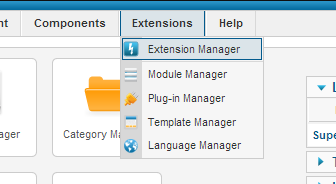
Y'all see the page "Extension Managing director"
From here you tin can install your Templates, Plugins, Modules, Components and Languages. Y'all take three options:
- Upload Package File - (select a package from your PC, upload and install it)
- Install from Directory - (enter the path where the package is located on your server)
- Install from URL - (enter the URL to the parcel)
Here, we cull the first method: Upload Packet File
Select the package from your PC and click the button "Upload File & Install"

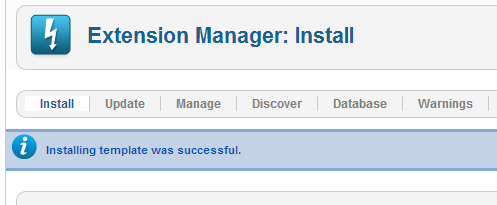
If the package contains no errors you are done and get a success message like the one below.
Install via FTP (unpacked template file) [edit]
Templates can also be installed via FTP without packaging them. Simply select the template folder on your PC and upload information technology to your server, using your favorite FTP software. Be sure you lot upload the template binder to the directory: /path_to_joomla/templates/ - where /path_to_joomla/ is the location of your Joomla! installation on the server. This method is mostly used when you have created a template yourself, and do not want to have to package information technology to install the template, or if you desire to upload more than ane template at once. You must and so go into extension manager and click on Observe in the sub menu. Click on "Discover" in the toolbar if your template doesn't immediately announced. A list of uninstalled items in the FTP should and so appear. Click the checkbox to the left of your template and click install.
Note: Do not try to utilise FTP to install Components, Modules and Plugins if you lot are a beginner/novice. These items demand database entries which take to be inserted manually if you bypass the package installer.

How To Change Template Joomla 2.5,
Source: https://docs.joomla.org/J2.5:Getting_Started_with_Templates
Posted by: kearnsdureal.blogspot.com
0 Response to "How To Change Template Joomla 2.5"
Post a Comment