

How To Take A Template From One Amino And Put It Into Another Amino App
The Cellular Level of Organization
Poly peptide Synthesis
Learning Objectives
By the cease of this section, y'all will be able to:
- Explain how the genetic code stored within DNA determines the protein that will form
- Describe the process of transcription
- Depict the process of translation
- Discuss the function of ribosomes
It was mentioned earlier that DNA provides a "design" for the cell structure and physiology. This refers to the fact that Deoxyribonucleic acid contains the information necessary for the cell to build i very of import type of molecule: the protein. Most structural components of the cell are fabricated up, at to the lowest degree in part, by proteins and virtually all the functions that a cell carries out are completed with the help of proteins. I of the nearly of import classes of proteins is enzymes, which assistance speed upward necessary biochemical reactions that take identify inside the cell. Some of these critical biochemical reactions include building larger molecules from smaller components (such as occurs during Deoxyribonucleic acid replication or synthesis of microtubules) and breaking down larger molecules into smaller components (such as when harvesting chemical energy from food molecules). Whatever the cellular process may be, it is almost certain to involve proteins. Just every bit the cell's genome describes its full complement of Dna, a prison cell's proteome is its total complement of proteins. Poly peptide synthesis begins with genes. A cistron is a functional segment of Dna that provides the genetic information necessary to build a poly peptide. Each particular factor provides the lawmaking necessary to construct a particular poly peptide. Gene expression, which transforms the information coded in a gene to a final gene product, ultimately dictates the structure and function of a jail cell past determining which proteins are fabricated.
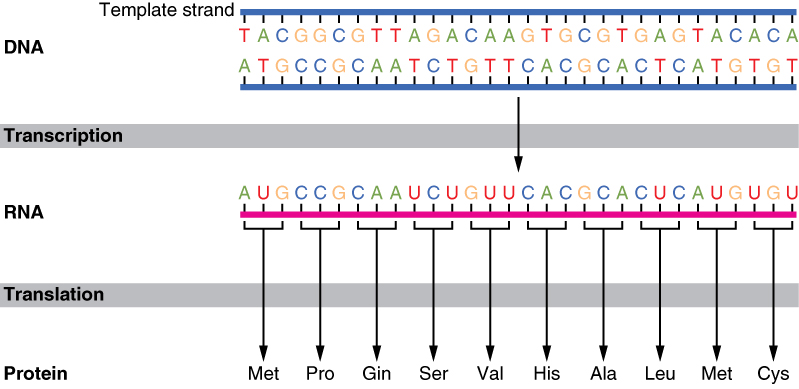
The estimation of genes works in the following way. Recall that proteins are polymers, or chains, of many amino acid building blocks. The sequence of bases in a gene (that is, its sequence of A, T, C, G nucleotides) translates to an amino acid sequence. A triplet is a department of 3 Deoxyribonucleic acid bases in a row that codes for a specific amino acid. Similar to the way in which the three-letter code d-o-g signals the epitome of a dog, the 3-letter Dna base code signals the apply of a particular amino acrid. For instance, the DNA triplet CAC (cytosine, adenine, and cytosine) specifies the amino acid valine. Therefore, a cistron, which is composed of multiple triplets in a unique sequence, provides the code to build an entire poly peptide, with multiple amino acids in the proper sequence ((Figure)). The mechanism by which cells turn the Deoxyribonucleic acid lawmaking into a protein product is a two-step process, with an RNA molecule as the intermediate.
The Genetic Code
DNA holds all of the genetic information necessary to build a cell'southward proteins. The nucleotide sequence of a cistron is ultimately translated into an amino acid sequence of the gene'south corresponding protein.
From DNA to RNA: Transcription
DNA is housed inside the nucleus, and protein synthesis takes place in the cytoplasm, thus there must be some sort of intermediate messenger that leaves the nucleus and manages protein synthesis. This intermediate messenger is messenger RNA (mRNA), a single-stranded nucleic acrid that carries a copy of the genetic code for a single gene out of the nucleus and into the cytoplasm where it is used to produce proteins.
There are several different types of RNA, each having unlike functions in the jail cell. The construction of RNA is like to Dna with a few small exceptions. For ane affair, unlike DNA, most types of RNA, including mRNA, are single-stranded and comprise no complementary strand. Second, the ribose sugar in RNA contains an additional oxygen atom compared with DNA. Finally, instead of the base of operations thymine, RNA contains the base uracil. This means that adenine will e'er pair upward with uracil during the protein synthesis process.
Gene expression begins with the process called transcription, which is the synthesis of a strand of mRNA that is complementary to the factor of interest. This process is called transcription considering the mRNA is like a transcript, or copy, of the gene'due south DNA code. Transcription begins in a fashion somewhat like Deoxyribonucleic acid replication, in that a region of DNA unwinds and the ii strands separate, however, but that small portion of the DNA will be split apart. The triplets within the gene on this section of the DNA molecule are used every bit the template to transcribe the complementary strand of RNA ((Figure)). A codon is a three-base sequence of mRNA, so-chosen because they directly encode amino acids. Like Deoxyribonucleic acid replication, there are iii stages to transcription: initiation, elongation, and termination.
Transcription: from DNA to mRNA
In the showtime of the ii stages of making protein from Deoxyribonucleic acid, a gene on the DNA molecule is transcribed into a complementary mRNA molecule.
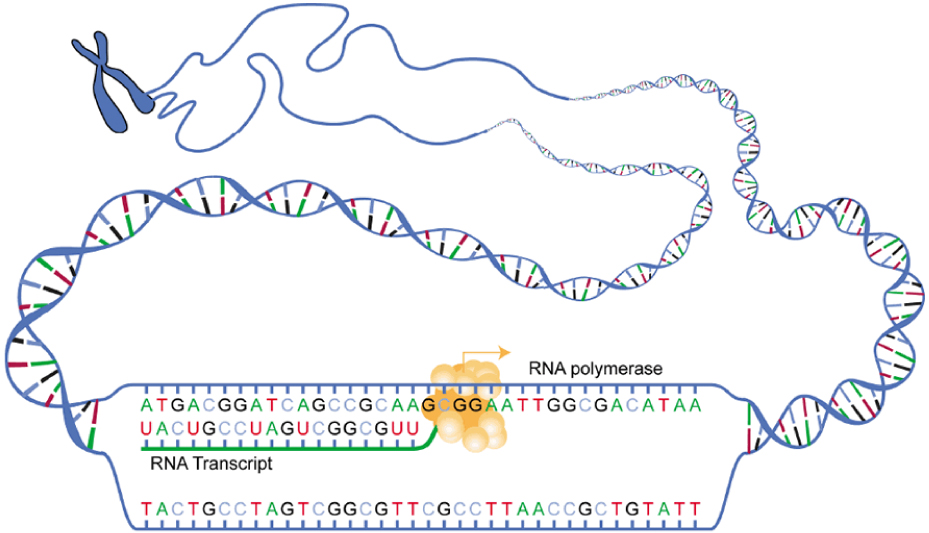
Phase one: Initiation. A region at the beginning of the gene called a promoter—a detail sequence of nucleotides—triggers the outset of transcription.
Stage 2: Elongation. Transcription starts when RNA polymerase unwinds the DNA segment. One strand, referred to as the coding strand, becomes the template with the genes to exist coded. The polymerase and then aligns the correct nucleic acid (A, C, Yard, or U) with its complementary base on the coding strand of Dna. RNA polymerase is an enzyme that adds new nucleotides to a growing strand of RNA. This procedure builds a strand of mRNA.
Stage 3: Termination. When the polymerase has reached the stop of the cistron, i of iii specific triplets (UAA, UAG, or UGA) codes a "stop" signal, which triggers the enzymes to cease transcription and release the mRNA transcript.
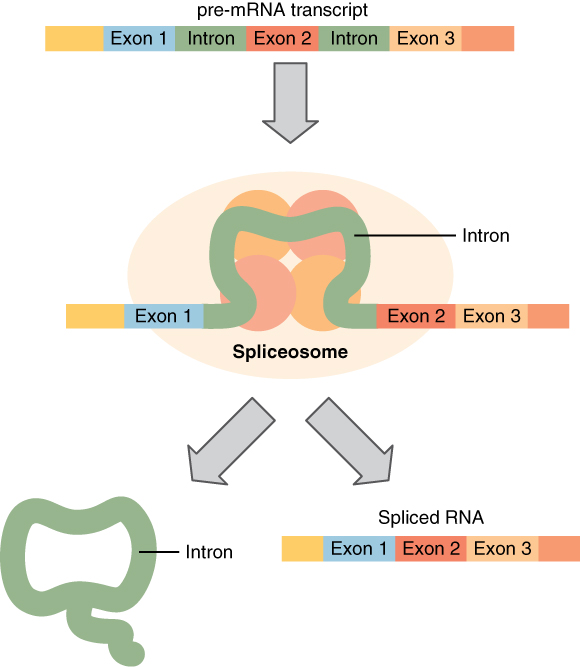
Before the mRNA molecule leaves the nucleus and proceeds to protein synthesis, it is modified in a number of means. For this reason, it is often called a pre-mRNA at this phase. For example, your Dna, and thus complementary mRNA, contains long regions called not-coding regions that exercise non code for amino acids. Their function is still a mystery, but the process called splicing removes these non-coding regions from the pre-mRNA transcript ((Figure)). A spliceosome—a construction composed of various proteins and other molecules—attaches to the mRNA and "splices" or cuts out the not-coding regions. The removed segment of the transcript is called an intron. The remaining exons are pasted together. An exon is a segment of RNA that remains afterwards splicing. Interestingly, some introns that are removed from mRNA are not always not-coding. When different coding regions of mRNA are spliced out, different variations of the protein will eventually outcome, with differences in structure and function. This process results in a much larger variety of possible proteins and poly peptide functions. When the mRNA transcript is set up, information technology travels out of the nucleus and into the cytoplasm.
Splicing DNA
In the nucleus, a structure called a spliceosome cuts out introns (noncoding regions) inside a pre-mRNA transcript and reconnects the exons.
From RNA to Protein: Translation
Like translating a book from ane language into another, the codons on a strand of mRNA must exist translated into the amino acid alphabet of proteins. Translation is the process of synthesizing a chain of amino acids chosen a polypeptide. Translation requires 2 major aids: first, a "translator," the molecule that volition conduct the translation, and second, a substrate on which the mRNA strand is translated into a new protein, similar the translator'due south "desk." Both of these requirements are fulfilled by other types of RNA. The substrate on which translation takes place is the ribosome.
Remember that many of a cell'south ribosomes are establish associated with the rough ER, and carry out the synthesis of proteins destined for the Golgi apparatus. Ribosomal RNA (rRNA) is a blazon of RNA that, together with proteins, composes the construction of the ribosome. Ribosomes exist in the cytoplasm equally two singled-out components, a small and a large subunit. When an mRNA molecule is ready to be translated, the two subunits come together and attach to the mRNA. The ribosome provides a substrate for translation, bringing together and aligning the mRNA molecule with the molecular "translators" that must decipher its lawmaking.
The other major requirement for poly peptide synthesis is the translator molecules that physically "read" the mRNA codons. Transfer RNA (tRNA) is a type of RNA that ferries the appropriate corresponding amino acids to the ribosome, and attaches each new amino acid to the last, building the polypeptide chain i-by-one. Thus tRNA transfers specific amino acids from the cytoplasm to a growing polypeptide. The tRNA molecules must be able to recognize the codons on mRNA and friction match them with the right amino acrid. The tRNA is modified for this function. On ane end of its structure is a binding site for a specific amino acid. On the other finish is a base sequence that matches the codon specifying its item amino acrid. This sequence of three bases on the tRNA molecule is called an anticodon. For example, a tRNA responsible for shuttling the amino acid glycine contains a binding site for glycine on one end. On the other end it contains an anticodon that complements the glycine codon (GGA is a codon for glycine, and and then the tRNAs anticodon would read CCU). Equipped with its detail cargo and matching anticodon, a tRNA molecule tin read its recognized mRNA codon and bring the respective amino acid to the growing chain ((Effigy)).
Translation from RNA to Protein
During translation, the mRNA transcript is "read" past a functional complex consisting of the ribosome and tRNA molecules. tRNAs bring the appropriate amino acids in sequence to the growing polypeptide chain by matching their anti-codons with codons on the mRNA strand.
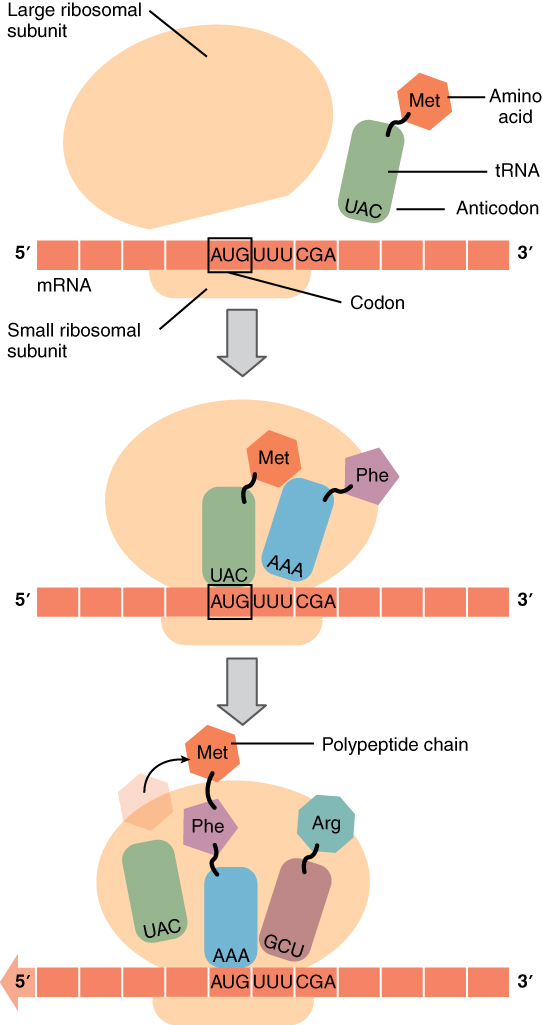
Much similar the processes of DNA replication and transcription, translation consists of three main stages: initiation, elongation, and termination. Initiation takes identify with the binding of a ribosome to an mRNA transcript. The elongation phase involves the recognition of a tRNA anticodon with the next mRNA codon in the sequence. One time the anticodon and codon sequences are bound (remember, they are complementary base pairs), the tRNA presents its amino acid cargo and the growing polypeptide strand is attached to this next amino acrid. This attachment takes place with the assistance of various enzymes and requires energy. The tRNA molecule then releases the mRNA strand, the mRNA strand shifts one codon over in the ribosome, and the side by side advisable tRNA arrives with its matching anticodon. This process continues until the final codon on the mRNA is reached which provides a "stop" message that signals termination of translation and triggers the release of the complete, newly synthesized protein. Thus, a gene within the DNA molecule is transcribed into mRNA, which is and so translated into a protein product ((Figure)).
From Dna to Poly peptide: Transcription through Translation
Transcription within the cell nucleus produces an mRNA molecule, which is modified so sent into the cytoplasm for translation. The transcript is decoded into a protein with the help of a ribosome and tRNA molecules.

Ordinarily, an mRNA transcription will be translated simultaneously by several next ribosomes. This increases the efficiency of protein synthesis. A single ribosome might translate an mRNA molecule in approximately one infinitesimal; and then multiple ribosomes aboard a single transcript could produce multiple times the number of the same poly peptide in the same minute. A polyribosome is a string of ribosomes translating a unmarried mRNA strand.
Spotter this video to acquire nearly ribosomes. The ribosome binds to the mRNA molecule to offset translation of its code into a protein. What happens to the small-scale and large ribosomal subunits at the end of translation?
Chapter Review
DNA stores the data necessary for instructing the cell to perform all of its functions. Cells use the genetic lawmaking stored within DNA to build proteins, which ultimately decide the structure and function of the cell. This genetic code lies in the particular sequence of nucleotides that make up each factor along the DNA molecule. To "read" this code, the prison cell must perform ii sequential steps. In the offset stride, transcription, the DNA lawmaking is converted into a RNA code. A molecule of messenger RNA that is complementary to a specific gene is synthesized in a process similar to Dna replication. The molecule of mRNA provides the lawmaking to synthesize a poly peptide. In the process of translation, the mRNA attaches to a ribosome. Next, tRNA molecules shuttle the appropriate amino acids to the ribosome, one-by-one, coded by sequential triplet codons on the mRNA, until the poly peptide is fully synthesized. When completed, the mRNA detaches from the ribosome, and the protein is released. Typically, multiple ribosomes attach to a unmarried mRNA molecule at in one case such that multiple proteins can be manufactured from the mRNA concurrently.
Interactive Link Questions
Watch this video to learn about ribosomes. The ribosome binds to the mRNA molecule to get-go translation of its code into a protein. What happens to the small and large ribosomal subunits at the end of translation?
They split and move and are complimentary to join translation of other segments of mRNA.
Review Questions
Which of the following is non a departure between DNA and RNA?
- Deoxyribonucleic acid contains thymine whereas RNA contains uracil
- Deoxyribonucleic acid contains deoxyribose and RNA contains ribose
- Deoxyribonucleic acid contains alternating sugar-phosphate molecules whereas RNA does not contain sugars
- RNA is unmarried stranded and DNA is double stranded
Transcription and translation take place in the ________ and ________, respectively.
- nucleus; cytoplasm
- nucleolus; nucleus
- nucleolus; cytoplasm
- cytoplasm; nucleus
How many "letters" of an RNA molecule, in sequence, does it take to provide the lawmaking for a unmarried amino acrid?
- 1
- ii
- iii
- 4
Which of the following is not made out of RNA?
- the carriers that shuffle amino acids to a growing polypeptide strand
- the ribosome
- the messenger molecule that provides the code for poly peptide synthesis
- the intron
B
Critical Thinking Questions
Briefly explicate the similarities between transcription and DNA replication.
Transcription and DNA replication both involve the synthesis of nucleic acids. These processes share many common features—particularly, the similar processes of initiation, elongation, and termination. In both cases the Deoxyribonucleic acid molecule must be untwisted and separated, and the coding (i.due east., sense) strand will be used as a template. Besides, polymerases serve to add nucleotides to the growing DNA or mRNA strand. Both processes are signaled to terminate when completed.
Contrast transcription and translation. Name at least iii differences between the two processes.
Transcription is actually a "copy" process and translation is really an "estimation" process, because transcription involves copying the DNA bulletin into a very similar RNA message whereas translation involves converting the RNA message into the very different amino acrid message. The two processes also differ in their location: transcription occurs in the nucleus and translation in the cytoplasm. The mechanisms by which the two processes are performed are too completely different: transcription utilizes polymerase enzymes to build mRNA whereas translation utilizes different kinds of RNA to build protein.
Glossary
- anticodon
- consecutive sequence of three nucleotides on a tRNA molecule that is complementary to a specific codon on an mRNA molecule
- codon
- consecutive sequence of three nucleotides on an mRNA molecule that corresponds to a specific amino acid
- exon
- one of the coding regions of an mRNA molecule that remain after splicing
- gene
- functional length of Dna that provides the genetic information necessary to build a protein
- gene expression
- active interpretation of the information coded in a gene to produce a functional gene product
- intron
- non-coding regions of a pre-mRNA transcript that may be removed during splicing
- messenger RNA (mRNA)
- nucleotide molecule that serves as an intermediate in the genetic code between DNA and protein
- polypeptide
- chain of amino acids linked past peptide bonds
- polyribosome
- simultaneous translation of a single mRNA transcript past multiple ribosomes
- promoter
- region of DNA that signals transcription to begin at that site inside the gene
- proteome
- full complement of proteins produced by a prison cell (adamant past the cell'south specific gene expression)
- ribosomal RNA (rRNA)
- RNA that makes up the subunits of a ribosome
- RNA polymerase
- enzyme that unwinds Dna and then adds new nucleotides to a growing strand of RNA for the transcription phase of protein synthesis
- spliceosome
- complex of enzymes that serves to splice out the introns of a pre-mRNA transcript
- splicing
- the procedure of modifying a pre-mRNA transcript by removing sure, typically not-coding, regions
- transcription
- process of producing an mRNA molecule that is complementary to a item gene of DNA
- transfer RNA (tRNA)
- molecules of RNA that serve to bring amino acids to a growing polypeptide strand and properly place them into the sequence
- translation
- process of producing a protein from the nucleotide sequence code of an mRNA transcript
- triplet
- consecutive sequence of iii nucleotides on a DNA molecule that, when transcribed into an mRNA codon, corresponds to a particular amino acid

How To Take A Template From One Amino And Put It Into Another Amino App,
Source: https://opentextbc.ca/anatomyandphysiologyopenstax/chapter/protein-synthesis/
Posted by: kearnsdureal.blogspot.com
0 Response to "How To Take A Template From One Amino And Put It Into Another Amino App"
Post a Comment